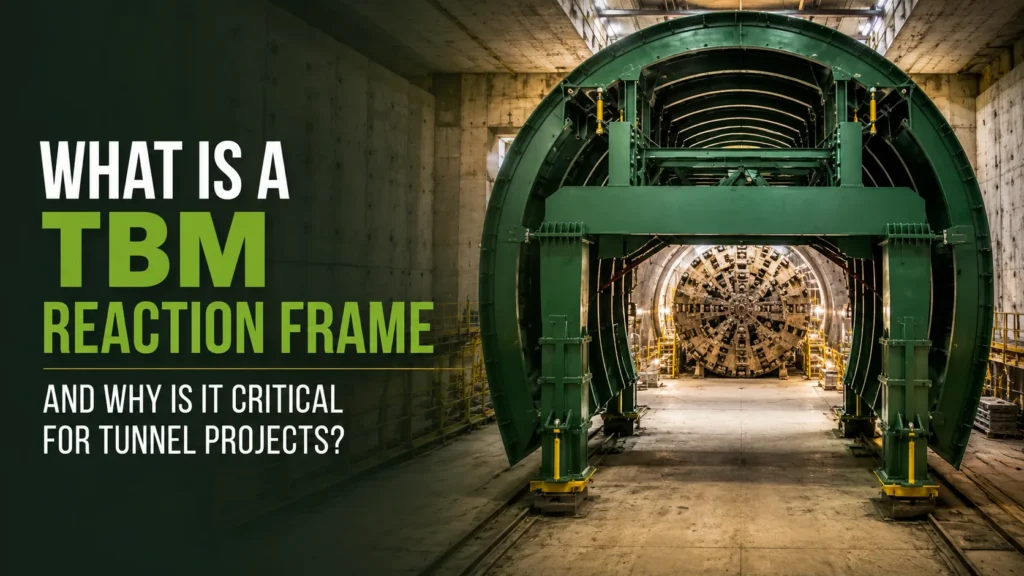
Rapid growth in India’s infrastructure has increased demand for advanced equipment for both underground and passway construction. With tunnelling projects increasing across the nation, the TBM Reaction Frame plays a vital role.
If you are in charge of a tunnelling project, know how a TBM Reaction Frame in India can help. Here’s what we have discussed in this article.
Table of Contents
What is a TBM Reaction Frame?
A TBM Reaction Frame is a temporary heavy steel or concrete structure used in the initial phase of tunnel excavation. It is placed in a starting shaft to provide a stable, immovable surface for the TBM’s hydraulic jacks to push against. This allows the machine to advance before the permanent tunnel lining is installed.
How does a TBM Reaction Frame work?
TBM reaction frames might not be necessary for the entire tunnelling structure. Tunnelling projects are usually massive and place heavy pressure on both the structures and the surrounding areas.
To advance the TBM, hydraulic thrust cylinders exert force against this temporary frame, allowing it to absorb the substantial forward loads and distribute them safely into the launch shaft’s concrete walls. Once the load is evenly distributed, the risk of structural damage and collapse significantly reduces.
Why are TBM Reaction Frames critical for tunnel projects?
India’s tunnelling projects require reliability and innovation to withstand challenging situations. As an expert manufacturer of TBM reaction frames in India, our structures can help your tunnelling projects by:
- Enabling Machine Launch
The TBM reaction frame is often combined with a thrust ring and shield cradle, which absorb the initial high load forces and direct them evenly into the shaft foundation. As a result, the TBM’s cutter head is pressed firmly against the unexcavated earth, enabling the in-machine launch.
- Controlling Steering and Alignment
TBM reaction frame ensures that the TBM remains perfectly aligned with the planned tunnel axis. This precision prevents the machine from drifting off or losing proper ring plane during early excavation stages.
- Protecting the Tunnel Lining
Once the TBM has left the launch shaft and is fully underground, the TBM reaction frames shift to a different function. It evenly distributes the massive hydraulic thrust forces of the TBM jacks against the newly installed, precast concrete segments. This prevents cracking and structural damage to the tunnel walls.
- Enhancing Operational Safety
A properly designed and installed reaction frame reduces the risk of equipment failure or structural instability in tunnelling projects. This function not only protects the TBM but also ensures the safety of workers and the surrounding environment.
Connect with NPEC for Superior Tunnelling Projects
Numerous underground projects, such as the Delhi Metro, Mumbai Metro, and Bangalore Metro, require tunnel boring machines. For the swift operation of these machines, an efficient TBM Reaction Frame is required.
National Power Engineering Company (NPEC) is India’s No 1 Manufacturer and contractor of modern TBM reaction frames. From raw material sourcing to construction, we provide a one-stop solution for tunnelling projects in India.
Get a Quote and Start Your Project today.
What are the risks of an improperly designed TBM reaction frame?
An inadequate reaction frame can lead to excessive structural stress, launch instability, equipment damage, project delays, and serious safety hazards, making proper engineering and installation essential.
When is a TBM reaction frame removed?
The reaction frame is typically dismantled once the TBM has advanced far enough for the installed tunnel lining segments to withstand and transfer the required thrust forces.
Which tunnel projects require a TBM reaction frame?
Reaction frames are commonly used in metro trial tunnels, highway tunnels, railway tunnels, utility tunnels, water supply projects, sewer systems, and hydroelectric tunnel construction where TBMs are launched from shafts.