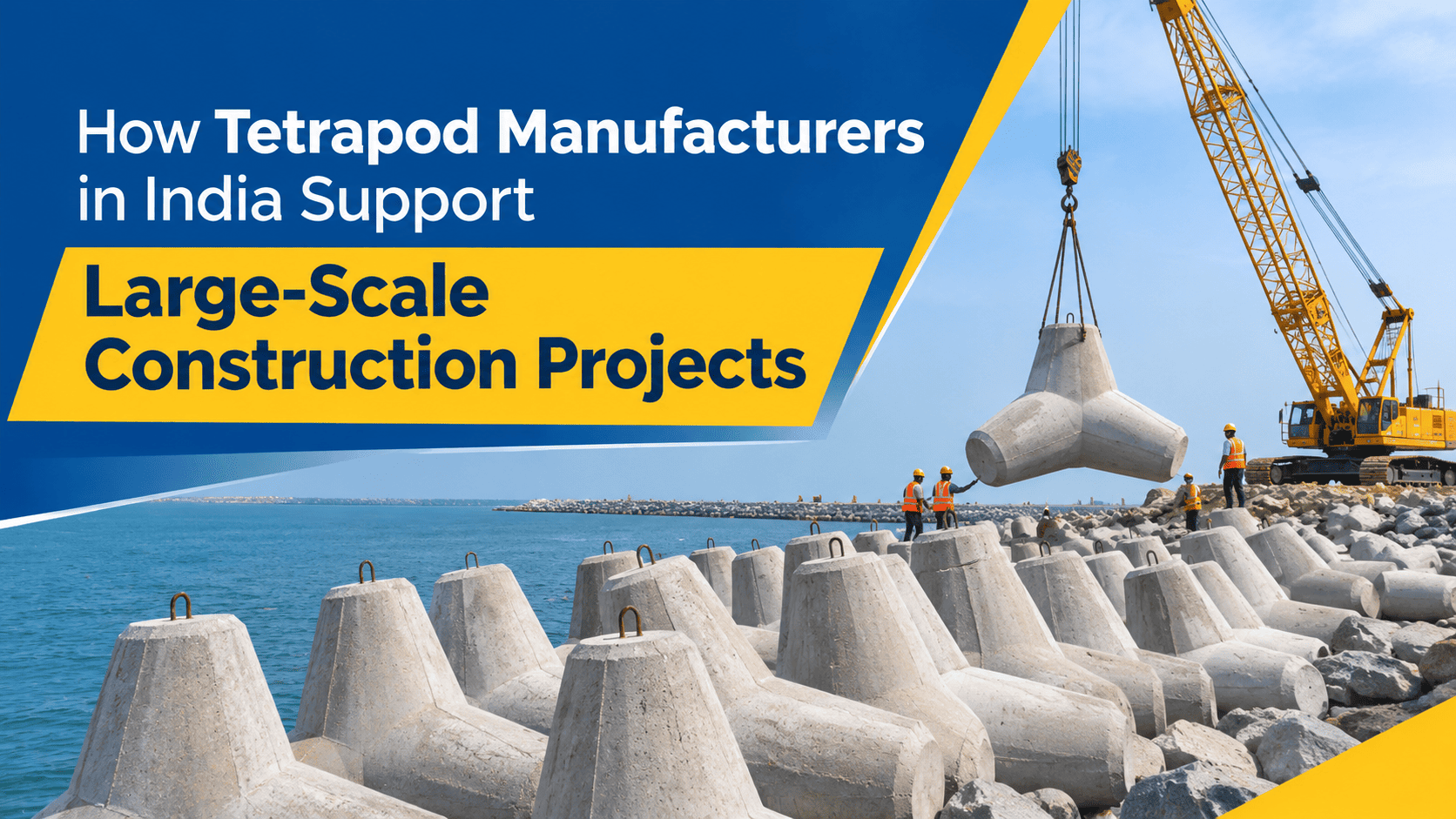
Ports, harbours, breakwaters, coastal protection, and marine infrastructure are common in many large-scale construction projects and must withstand demanding environments, including powerful waves.
These concrete structures help reduce wave energy, address shoreline issues, and improve coastal stability. Using trustworthy vendors in India that manufacture quality concrete armour units is one way to build infrastructure.
Tetrapod manufacturers in India provide the strength, durability and timely completion of major projects – from material selection and mould preparation, through the pouring of the concrete to checking its quality. This is why they play a crucial role in coastal infrastructure, where the structure itself is vital to long-term safety.
Table of Contents
1. Supplying Durable Concrete Armour Units
Tetrapods are used along coasts to protect against wave forces. These heavy concrete blocks are designed to be placed together to form a barrier against wave forces.
Indian tetrapod producers provide units in various sizes and weights to support large bridge and harbour construction projects.
These concrete structures are often put to use:
- Coastal protection and stabilisation of the shoreline
- Breakwater and seawall construction
- Harbour and port facilities
- Protection of marine structures against wave impact
- Erosion Prevention for Sensitive Coasts
Positioning the tetrapods correctly increases the durability and stability of the protection system.
2. Addressing Customised Project Needs
Every structure requires unique specifications based on the environment. The height of the waves, current water depth, tide, seabed environment, and required structural design loading will all be considered in the selection process.
They will cooperate with the engineering group and also with the contractors in determining these requirements. The manufacturing group can produce the concrete armour units in various dimensions and weights, depending on the approved project design.
Specialised production enables the contractor to choose the most suitable units for different sections of a breakwater, protection works, and other projects involving marine infrastructure.
3. Maintaining Concrete Quality and Structural Strength
Concrete quality is one of the most critical factors for tetrapods. They must withstand repeated attacks from wave forces, weather, and transport and handling. Manufacturers work on construction projects while adhering to strict guidelines in the concrete manufacturing process.
The critical issues for quality are:
-
Material selection
Cement, aggregates, water and admixtures should comply with the specified standards.
-
Concrete mix design
The mix must meet critical durability and toughness requirements.
-
Mould quality
Accurately tamping the moulds provides the correct form and size.
-
Curing practices
Appropriate curing supports concrete strength development.
-
Quality testing
Apply tests and inspections to concrete samples and finished units. Quality manufacturing throughout the product life cycle minimises built-in weaknesses.
4. Guaranteeing a Large Volume Production Capacity
Large-scale construction requires many concrete tetrapods within a specified construction timetable. Delays in production also delay transportation, site mobilisation, and installation.
Organised manufacture for these projects with authorised manufacturers in proper moulding machines, facilitated by the selected builders and concrete batching men.
The Mangalore Coastal Protection Project, for instance, where 6,500 structures were deployed in India, shows the lessons learned here about the need for a coordinated approach between installation and manufacture in large-scale marine works.
If a manufacturer has extra capacity, it can provide contractors with it throughout various stages of construction.
5. Assisting Transportation and Site Coordination
However, concrete tetrapods are very large concrete objects that need to be transported. Their size and weight is challenging to handle, especially at isolated coastal sites or near marine facilities.
Indian Tetrapod manufacturer helps in project execution by coordinating:
- Secure loading and unloading procedures
- Transporting with the right large transport vehicles
- Planning deliveries to match construction deadlines.
- Safe storage and onsite handling.
- Ensuring our supply arrives on time, in line with your site contractor’s timeline.
Effective logistics mitigates material-handling difficulties and eliminates avoidable delays in the construction process.
6. Assisting in Coastal Defences and Infrastructure Projects
India, coastal protection has also become a major part of infrastructure development. Ports, fishing harbours, seawalls, breakwaters, etc. need protection from wave attack and erosion.
Tetrapods manufactured by NPEC (National Power Engineering Company) disperse the energy of incoming waves through their form and arrangement. They act as an armour layer around the coastal structure. Tetrapod shape and design influence performance, including hydraulic design, unit weight, placement pattern, and site conditions.
By providing manufactured concrete armour units, manufacturers help facilitate infrastructure projects that promote resilience to the effects of the seashore and evolving marine conditions.
Conclusion
Tetrapod manufacturers in India are part of the Indian construction industry and support large-scale infrastructure projects across the country. Their services extend beyond concrete production to include manufacturing, technical coordination, supply, bulk carting, and quality management.
Experienced manufacturer – working with a knowledgeable manufacturer allows contractors to secure long-lasting concrete armour units to specification, helping them deliver successful projects. As investment increases in ports, harbours and coastal protection, continued investment in tetrapod manufacturing capabilities will be essential.
Frequently Asked Questions
1. What are tetrapods used for in construction?
Tetrapods provide stability and prevent erosion along coastlines by absorbing and dissipating the power of incoming waves. They absorb wave energy in breakwaters, seawalls, and coastal defence structures.
2. What material are tetrapods made of?
Most tetrapod units are made of cement concrete with suitable admixtures, aggregates, and water.
3. Are tetrapods size scalable?
Yes, manufacturers cast tetrapods in various weights and sizes in accordance with approved project plans.