Steel bridges are complex structures that require strict adherence to engineering principles at every stage, from design to fabrication, transportation, erection, and final installation. A steel bridge manufacturer in North East India must consider several factors, including structural design, site conditions, material quality, fabrication accuracy, and ease of erection. The steel bridge fabrication process is the systematic procedure NPEC uses to produce steel structures from engineering drawings to on-site support.
Table of Contents
The Factors that determine Steel Bridge Fabrication works from Design to Erection
1. Bridge Design and Engineering
Steel Bridge Fabrication Begins With the Engineering and Design Engineers review all aspects of the span, including the specific length, width, and loading conditions. The engineer must also consider the foundation arrangement, site conditions, alignment, and construction.
The next step is to produce drawings for major items, including the girders, trusses, crossbeams, bracing members, stiffeners, plates, and connection members. Fabrication drawings will show the dimensions, material specifications, weld details, connection requirements, and assembly information for the fabrication team.
2. Material Selection and Procurement
Procure, select, and order structural steel to meet the project’s specifications. Material quality is of concern, as a bridge’s structural members are subjected to perpetual structural forces and varying environmental conditions. Steel plates, sections, and other fabrication materials are checked before fabrication. Identifying and documenting the materials used for fabrication further ensures traceability.
3. Cutting and Preparation of Steel
Once materials are checked and agreed, we cut steel plates and sections to suit the fabrication drawings. By using modern cutting equipment, we can produce fabrications to tight manufacturing tolerances with minimal waste.
We then prepare the edges for welding and mark the part for identification and future assembly. It is important to cut, prepare, and fit up the component correctly, as any dimensional inaccuracies at this stage could affect the fit-up or alignment of larger bridge components.
4. Component Fabrication and Welding
The separate steel components are joined as specified in the approved drawings, including flanges, stiffeners, webs, bracing members, plates, and so on.
Welding forms the permanent structural joints between parts. Structural fabrication must account for the welding sequence while managing weld and part alignment, distortion, and dimensional tolerances. Depending on project requirements, the welds and fabricated components are thoroughly inspected and tested for defects and quality assurance.
5. Assembly and Quality Inspection
Sub-assemblies may be assembled in the fabrication yard after fabrication for dimensional and connectivity checks before transport.
During this stage, fit-up or alignment problems can be identified and rectified before the bridge reaches the project site. Measurements, weld inspections, dimensional surveys and various quality-control operations can be completed.
A systematic quality control process is necessary for a steel bridge fabricator because problems left unaddressed until construction may delay projects and increase costs.
6. Surface Treatment and Protection
Steel bridge components will be prepared and coated to prevent corrosion and degradation from environmental exposure. The specification will specify the appropriate surface preparation, coating system, and system application requirements based on the project and site conditions. The coating system will extend the service life of the steel as a fabricated bridge component.
7. Transportation to the Project Site
Transport of large bridge components. We transport fabricated components from the manufacturing plant to the construction site. When planning transportation, we consider the component’s size and weight, the existing road network, access limitations, and lifting equipment.
Transportation for North East India projects can be tricky. Any road movements require detailed planning of the means of carriage due to Mountainous terrain, narrow roads, bridges, mountain passes, and remote sites.
8. Steel Bridge Erection
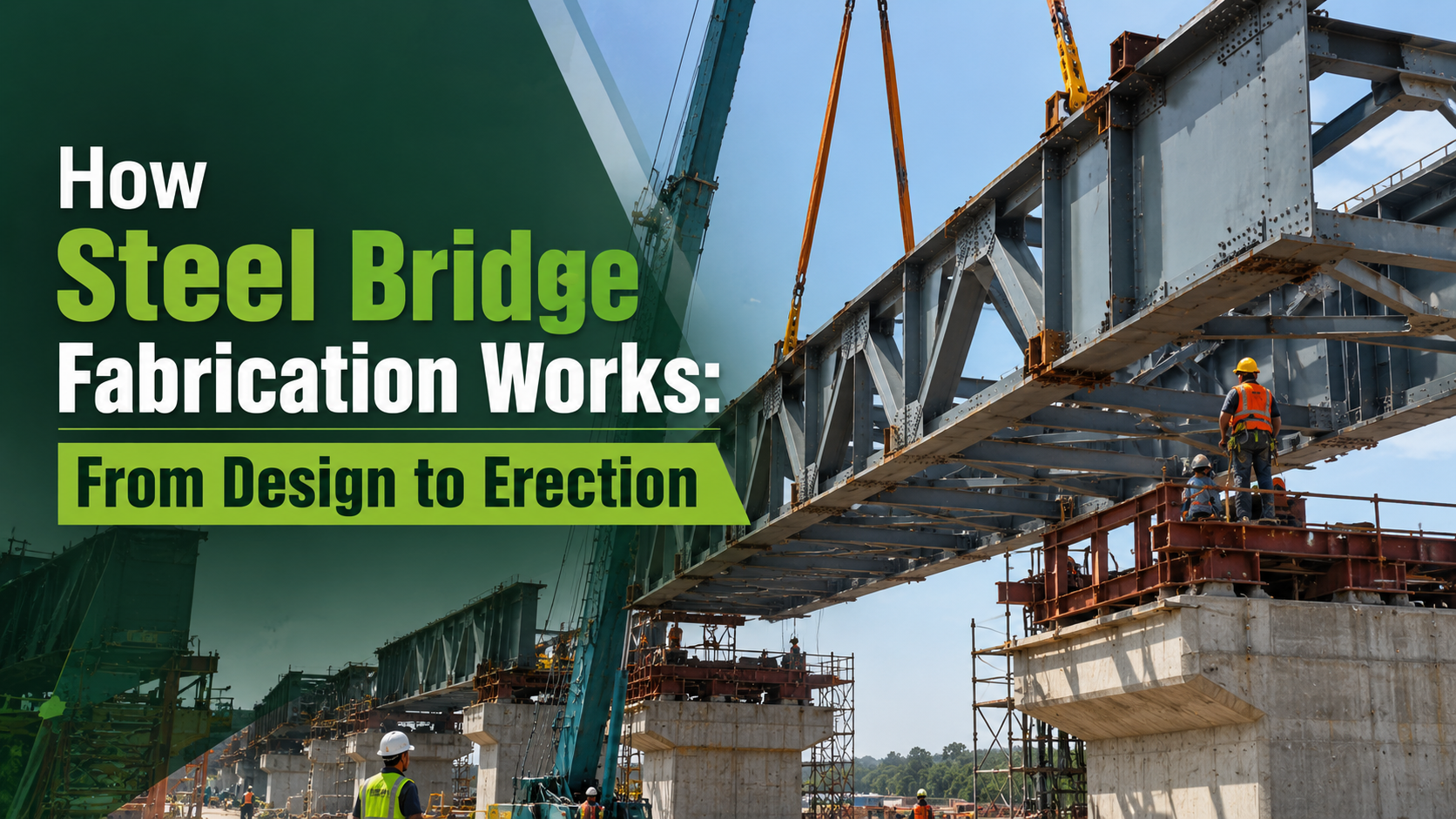
The last critical step is to assemble the pieces. Plant equipment arrives at the location, is manoeuvred into position, and assembled in accordance with the erection plan agreed upon for that structure. This is either done with a crane, with lifting equipment, temporary props, launching equipment, or other construction methods, depending on the type and location of the bridge.
The erection falsework sequence is not released until the structure is complete. Falsework is released and checked for set or other movement to ensure the structure is erected in the right order, that connections, level, and alignment are acceptable, and that the structure is stable.
NPEC as a Steel Bridge Fabricator
NPEC (National Power Engineering Company ) offers steel fabrication solutions for infrastructure projects and bridge-related structural needs. NPEC is a steel bridge manufacturer in North East India, with a factory capable of providing fabrication services along with the engineering and manufacturing needs of the project.
A bridge fabrication project is more than just producing steel parts. The key to success is moving the project from drawings and materials through fabrication, inspection, transportation, and erection in a carefully coordinated plan. NPEC’s standard bridge approach focuses on coordinating these steps for a predictable outcome.
Conclusion
Once materials are checked and agreed, we cut steel plates and sections to match the fabrication drawings. By using the latest cutting equipment, we can produce fabrications to tight manufacturing tolerances with minimal waste.
The edges can then be prepared for welding, and the part marked for identification and future assembly. It is important to cut, prepare, and fit up the component correctly, as any dimensional inaccuracies at this stage could affect the fit-up or alignment of larger bridge components.
FAQs
1. What are the various fabrication processes of a steel bridge?
Some well-known fabrication processes include design, material procurement, cutting, welding, assembly and inspection, surface treatment, transportation, and installation.
2. What do steel bridge fabricators do?
Steel bridge fabricators construct steel bridge parts, fabricating and inspecting them according to engineering drawings for installation at a given location.
3. Why is Quality Control necessary?
It helps to maintain the conformity of the material, welds, dimensions, connections, and fabricated items to the project requirements.